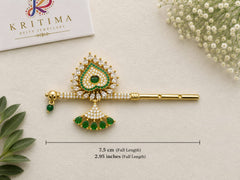
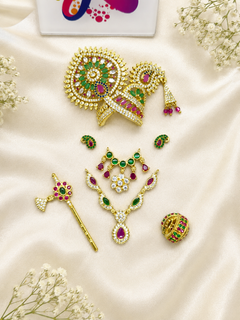
In Braj and in Pushti Marg seva, Thakur ji is often dressed in a paag (pagdi or turban) instead of a mukut. A pagdi gives a softer, everyday look, and it is the perfect base for a serpech and kalangi.
When to choose a pagdi over a mukut
- Everyday seva: a pagdi is lighter and more comfortable than a heavy mukut.
- Winter: a pagdi or woollen cap keeps the head warm.
- Pushti Marg shringaar: paag shringaar is a traditional style for Shrinathji and Thakur ji. See our Pushti Marg guide.
- Groom looks: for Tulsi Vivah or Vivah Panchami, a pagdi with kalangi looks like a dulha's safa.
Common styles
- Round paag: a neat, rounded turban for daily seva.
- Tilted or side paag: sits at an angle with a fall on one side, playful and Braj-style.
- Safa style: taller and more regal, with a tail at the back, ideal for festivals and weddings.
Colours by season
- Summer: white, cream, pastel and chandan colours.
- Monsoon: green and leheriya patterns.
- Winter: velvet or wool in maroon, mustard or deep blue.
- Festivals: red, gold and saffron.
Adding ornaments
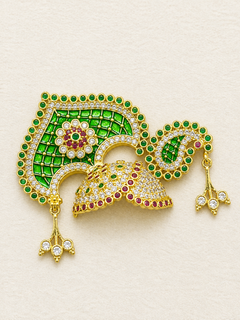
- Pin a serpech flat on the front.
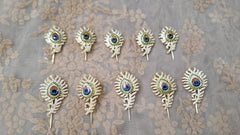
- Tuck a kalangi or morpankh behind it for height.
- Add a string of pearls (a lad) along the edge of the paag for a festive finish.
Our serpech and kalangi guide explains sizes and pinning in detail.
Sizing
Measure around Thakur ji's head just above the ears, the same as for a mukut. A pagdi should sit snugly without pressing. Check our size chart or WhatsApp a photo on 62677 19149.
Frequently asked questions
Can a pagdi and a mukut be worn together?
Usually one or the other. For a grand look, some families place a small mukut on top of a flat paag, but it must sit gently.
What is the difference between paag and pagdi?
They mean the same thing, a turban. Paag is the word commonly used in Braj and Pushti Marg seva.
 Laddu Gopal Ji Set
 Mukut
 Haar
 Choker
 Kalangi
 Bansi