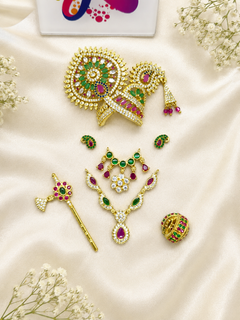
No Krishna shringaar is complete without his bansi. It is Kanha's most beloved companion, and choosing the right one makes a surprising difference to how the darshan looks.
Types of bansi
- Plain gold or silver bansi: simple and elegant, perfect for daily seva.
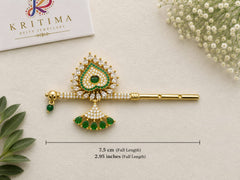
- Stone-studded bansi: set with coloured or AD stones for festivals.
- Pearl-hanging bansi: with small pearl drops that move gently, lovely for Sharad Purnima and weddings.
- Mor pankh bansi: decorated with peacock feather details, matching a mor mukut.
See the full range in our bansi collection.
Choosing the right length
A bansi should be roughly as long as the distance from Thakur ji's hand to just past the shoulder. Too short and it looks lost; too long and it overbalances the idol. Every listing gives the length in inches, so compare it with your idol before ordering.
How to place the bansi
- In the hand: many Laddu Gopal idols have a hand shaped to hold a bansi. Slide it in gently and rest the far end against the shoulder.
- Tucked in the poshak or kamarband: if the hand cannot hold it, tuck one end into the kamarband or the waist of the poshak.
- Standing Krishna: rest the bansi across both hands at the lips, as in the classic tribhanga pose.
Never force the bansi into a tight hand. If it doesn't fit, choose a slimmer one.
Matching the bansi
Match the bansi's metal finish to the mukut. A gold mukut looks best with a gold bansi, and silver with silver. Read our guide to gold vs silver polish for more.
Frequently asked questions
Should Radha Rani also have a bansi?
Traditionally the bansi is Krishna's. Some families place a second bansi as a playful touch, but it is not necessary.
My bansi keeps slipping. What can I do?
Tie it gently with a soft thread that matches the poshak, or tuck the end into the kamarband. Avoid glue.
 Laddu Gopal Ji Set
 Mukut
 Haar
 Choker
 Kalangi
 Bansi